
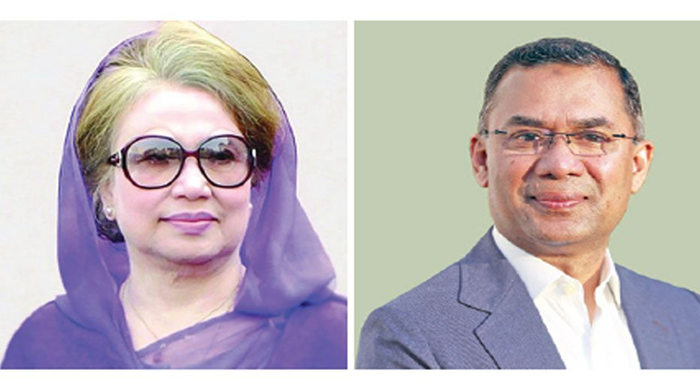
Special Correspondent : The arrest of Begum Khaleda Zia, her son and current Prime Minister and BNP Chairman Tarique Rahman, and another son Arafat Rahman Koko during the One-Eleven (1/11) regime was carried out under pressure from a section of civil society led by Prothom Alo Editor Matiur Rahman and The Daily Star Editor Mahfuz Anam. Two key figures of the One-Eleven transition, Lt Gen (retd) Masud Uddin Chowdhury and Maj Gen (retd) Mamun Khaled, reportedly disclosed this information to intelligence agencies.
According to intelligence sources, both identified Moti and Mahfuz as the principal conspirators behind One-Eleven during questioning.
General Masud Uddin, one of the most powerful figures during the One-Eleven period, provided crucial details regarding the matter while on remand. Multiple intelligence sources confirmed the information. The former army official stated that the military had initially opposed the arrest of Begum Zia and Tarique Rahman.
However, representatives of civil society – particularly the two editors – exerted significant pressure to have them arrested. He further claimed that the 2008 general election was held on the basis of an understanding between the caretaker government and the Awami League.
Masud Uddin was arrested from his residence in the capital’s Baridhara DOHS area on the night of 23 March. The following day, 24 March, the court granted a five-day remand for interrogation in a case filed with Paltan Model Thana. Subsequently, on 29 March, the court approved a second six-day remand. On 4 April, a third three-day remand was granted. Finally, on 7 April, following 14 days of remand across three phases in the Paltan case, he was produced before the court. On that day, he was shown arrested in the Delwar Hossain murder case and placed on a fresh four-day remand.
On 11 April, the court again approved a four-day remand for the high-profile One-Eleven figure, Lt Gen (retd) Masud Uddin Chowdhury. Multiple intelligence officials noted that he was primarily being interrogated regarding the 2007 One-Eleven conspiracy, during which he provided substantial and significant information.
The secret dinners and the military chain of command
Masud Uddin stated that the country’s political situation began to intensify in early 2006. At the time, he was serving as the GOC of the 9th Infantry Division – the most critical division and a central pillar of the Bangladesh Army. Owing to its strategic importance, he received a phone call from a prominent editor. The editor of the English-language daily The Daily Star expressed a desire to speak with him privately. Masud stated that when he invited the editor to Savar Cantonment, the invitation was declined. Instead, he was invited to a dinner at a residence in Gulshan, which he accepted.
Masud stated that in October 2006, he and his wife attended the dinner at the Gulshan residence of an industrialist who owned two influential newspapers. There, he was introduced to several other representatives of civil society, including the editor of Prothom Alo, a prominent economist, a writer, and an intellectual. The country’s ongoing political situation was discussed extensively. During a break in the dinner, the two editors and a renowned intellectual engaged him in a private conversation.
Masud claimed during interrogation that the role of the military in resolving the political crisis was discussed during the meeting. “I told all three of them that the army operates under a strict chain of command, so they should discuss the matter with the Army chief,” Gen Masud reportedly said. They informed him that they had already spoken with the Army chief, but that the chief was uncertain about Masud’s position. Masud responded by saying, “Whatever decision the Army Chief takes in the interests of the military and the nation, I will carry out.”
The ousting of Iajuddin and internal rivalries
Masud Uddin Chowdhury stated during remand that just one day after the dinner, the Army chief telephoned him and asked him to come to Army Headquarters for an emergency meeting. Masud noted that although General Moeen U Ahmed had once been a close friend, a distance had developed between them after Moeen became Army chief.
However, that distance reportedly narrowed during the meeting at Army Headquarters.
During the meeting, the political situation was discussed at length. Moeen informed him that the Awami League would not participate in the upcoming election. Masud initially doubted the claim. He stated, “If the Awami League boycotts the 22 January election, I will accept whatever decision the Army chief makes.”
Following this, the situation escalated rapidly. During remand, he stated that in a meeting with the Army chief on 8 January, the decision to remove the Iajuddin Ahmed government was finalised. Masud claimed that he was more popular within the military than the Army chief himself, which was why Moeen kept him at the forefront of operations during One-Eleven.
Depoliticisation and the Push for Arrests
During interrogation, Masud Uddin maintained that neither he nor the military wished to arrest members of Begum Zia’s family. The decision taken during the Core Command meeting was either to place them under house arrest or send them abroad. However, representatives of civil society – specifically the two editors, Matiur Rahman and Mahfuz Anam – allegedly exerted relentless pressure for their arrest.
Masud claimed: “I told them that the Martyred President Ziaur Rahman is highly respected within the military. Ordinary soldiers deeply revere him. Arresting the Zia family could trigger unrest within the army.”
However, the civil society representatives argued that unless the “Minus Two” formula was implemented – removing the country’s two top political leaders – political reform would be impossible. Masud stated that he then advised the two editors to build public opinion in favour of the move. Following this, both newspapers reportedly published a series of reports targeting the two leaders.
Matiur Rahman’s self-bylined article titled “The Two Leaders Must Step Down” allegedly served as the roadmap for the One-Eleven government. Masud Uddin claimed that everything during One-Eleven was carried out under the guidance of civil society, led by Matiur Rahman and Mahfuz Anam. He further alleged that, in preparation for One-Eleven, the two newspapers had been regularly publishing negative reports and opinion pieces against the BNP since 2005.
The influence of civil society on the caretaker government
Of the 16 advisers in the caretaker government formed on 11 January 2008 under the leadership of Fakhruddin Ahmed, nine were either regular columnists for, or closely associated with, the two newspapers, which acted as the mouthpieces of civil society. The newspapers regularly organised roundtable discussions and seminars featuring them. Among these advisers were AB Mirza Md Azizul Islam, Ayub Quadri, Dr Iftekhar Ahmed Chowdhury, Chowdhury Sajjadul Karim (CS Karim), AMM Shawkat Ali (former secretary), Rasheda K Choudhury and Dr Hossain Zillur Rahman.
Additionally, Barrister Hasan Arif served as legal counsel for the two newspapers, while Geeti Ara Safia Chowdhury was actively involved in various promotional campaigns for them.
Gen Masud claimed that a particular circle became highly active immediately after the BNP-led four-party alliance government assumed power in 2001. From the beginning of 2006, an influential Bengali-language daily and an English-language daily systematically launched negative campaigns against the government.
Under the pretext of selecting “qualified candidates”, nationwide seminars and roundtable discussions were organised with NGOs and representatives of civil society. The primary objective, he alleged, was to foster public resentment towards politicians.
Masud further claimed that certain influential quarters worked to steer the country’s political landscape in a particular direction during that period. According to him, under the guise of criticising the then BNP-led four-party alliance government, a Bengali-language daily and an English-language daily manufactured a public narrative that eroded trust in political leaders. He alleged that through this process, the concept of “depoliticisation” was actively promoted, with particular emphasis placed on news reporting and analysis to popularise the idea.
Intelligence officials believe that, in order to uncover the deeper truth behind the One-Eleven conspiracy, it is necessary to interrogate the two editors.


সম্পাদক : মোঃ সোহেল রানা
All rights reserved © 2022 banglapratidin24.com